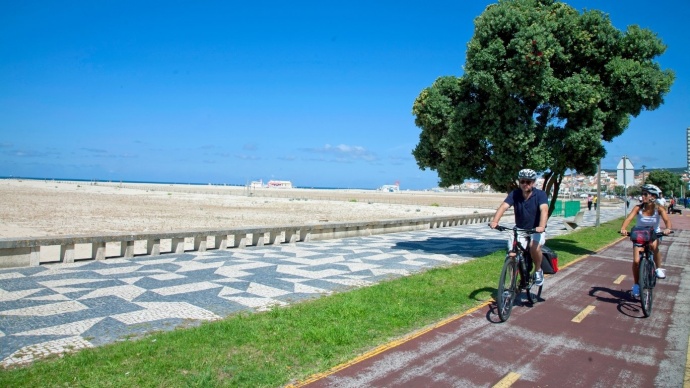

You can ride almost 50 km through central Portugal on a former railway, with little need to change gear. Or you can ride 44 km through the Douro vineyards and spend the day shifting between climbs and descents. The best cycling routes in Portugal depend as much on what happens between the start and finish as on the number beside the route.
These eight rides cover mainland Portugal, from the granite villages of the Minho to the salt pans of the eastern Algarve. Some make a good day out from one base. Others take you from town to town with somewhere new to sleep each night. If you’re still deciding which part of the country to visit, start with our regional guide to where to cycle in Portugal.
8 Portuguese cycling routes at a glance
Use the distances below to compare the rides. For a multi-day tour, the figure is the distance cycled across its stages. For a one-way day ride, you’ll need to allow for the trip back.
| Route | Distance and duration | What you’ll ride |
|---|---|---|
| Castro Laboreiro to Porto | 256–287 km (159–178 mi) · 6 stages | Mountain roads, river paths and Atlantic coast |
| Sabrosa to Peso da Régua | 44 km (27 mi) · 1 stage | Vineyard back roads and rolling hills |
| Viseu to Santa Comba Dão | About 49 km (30 mi) · 1 day | Paved rail trail with gentle gradients |
| Porto to Óbidos, finishing in Lisbon | 240 km (149 mi) ridden · 5 stages | Coastal cycle paths and roads, with transfers |
| Seia loop via Torre | 107 km (66 mi) · 1 long day | Mountain roads, a gravel section and 2,660 m of climbing |
| Évora to Vale de Paio | 31 km (19 mi) · one way | Old railway through open country, with unpaved stretches |
| São Torpes to Lagos | 185–192 km (115–119 mi) · 5 stages | Exposed Atlantic coast and rolling terrain |
| Vila Real de Santo António to Faro | About 70 km (43 mi) · 1–2 days | Lagoon-side tracks, cycle paths and road sections |
1. Castro Laboreiro to Porto for mountains, rivers and the Atlantic
Begin among the granite houses of Castro Laboreiro, high in the Peneda-Gerês area, and spend your first riding day making your way down to Monção. The 46 or 54 km stage crosses briefly into Spain. Around Monção the landscape opens into Alvarinho vineyards. On the next day the Minho River leads you past the fortifications of Valença on the way to Vila Praia de Âncora.
On our Minho to Porto self-guided bike tour, you ride about 256–287 km over six stages, depending on the options you choose. This is a good trip for a regular cyclist who enjoys variety and is comfortable descending on mountain roads. If time is short, the 36 km option from Vila do Conde to Porto makes a gentler introduction. You arrive by the mouth of the Douro, where the waterfront is an easier way into the city than its steep central streets. Our guide to cycling in Porto can help you plan the last few kilometers.
2. Sabrosa to Peso da Régua for vineyard back roads
From above the Douro, you can see why a vineyard ride feels so different from a riverside ride. The vines grow on narrow terraces cut into the slopes, and the back roads bend around the folds of the hillside. Sabrosa to Peso da Régua covers 44 km on the way down towards the river. You’ll still have hills to climb before the waterfront in Régua comes into view.
This is the final riding stage of our Douro Valley self-guided bike tour. Choose it if you like quiet roads, have a low gear for the climbs and enjoy stopping at viewpoints. Spring brings green growth to the terraces. September gives you a chance to see fruit coming in from the vineyards. If a cellar visit matters to you, allow time after the ride and use our guide to the Douro Valley harvest season to plan it.
3. The Ecopista do Dão for a first long ride
The old railway from Viseu through Tondela to Santa Comba Dão makes a forgiving first ride of about 49 km. A paved surface and the gentle gradients once needed by trains let you hold a steady rhythm. The line takes broad curves above the rivers, crosses old railway bridges and passes former stations. Look out for the locomotive at Torredeita and the metal bridge at Ortigueira.
Ride from Viseu for the generally easier direction. Allow most of the day if you want to stop for lunch and look around the stations. The finish is by the Santa Comba Dão railway station, outside the town center. Arrange your return before setting off, or ride a shorter out-and-back from Tondela if you have one car. A touring or hybrid bike works well here, and the shared path rewards a relaxed pace around walkers.
4. The Silver Coast from Porto to Óbidos for a week by the sea
Head south from Porto and the Atlantic changes character as you ride. Around Furadouro there are beaches and fishing towns. By Aveiro, the water is a lagoon edged by salt pans. Farther south, on the way to Nazaré, a stretch of the coastal cycle path runs between pine woods and the ocean at São Pedro de Moel. It’s a route for travelers who want to spend the evening exploring a town after a day on the bike.
Our Porto to Lisbon self-guided bike tour covers 240 km of riding over five stages. You cycle as far as Praia de Mira before a transfer to Figueira da Foz, then continue by bike to Nazaré and Óbidos. You hand back the bike in Óbidos and travel on to Lisbon. The Figueira da Foz–Nazaré stage is 81 km, twice the length of some other days. Use that figure when deciding whether the trip suits your group.
If you prefer a shorter longest day and like the idea of ending in a university city, the Porto to Coimbra bike tour turns inland at Figueira da Foz. Its final 45 km follow the lower Mondego through rice-growing country towards Coimbra.
5. A Serra da Estrela loop from Seia for experienced climbers
If long mountain passes are what you ride for, base yourself in Seia. The 107 km circuit through Loriga, Pedras Lavradas and Unhais da Serra takes on the climb to Torre before returning via Sabugueiro. Torre stands at 1,993 m, the highest point in mainland Portugal. Over the whole loop you’ll accumulate roughly 2,660 m of climbing, and the ascent out of Unhais even includes about 2 km of gravel.
This is a full mountain day for a confident cyclist. Choose low climbing gears and tires you trust on loose ground. Plan food and water stops in the villages, pack a layer you can put on at the summit and check access and the mountain forecast before you leave Seia. The descent comes late in the ride, when tired legs and cold hands can make a familiar road bike feel very different.
6. Évora to Vale de Paio for cork oaks and quiet Alentejo countryside
The Ecopista de Mora follows the old railway out of Évora into the montado, the open, park-like landscape of oaks and pasture typical of the Alentejo. The 31 km section to Vale de Paio passes olive groves and offers a chance to turn aside for Graça do Divor. Arraiolos, known for its hand-stitched wool rugs, is another possible detour. Add the extra distance when planning lunch or a pickup.
Choose this ride for gentle gradients, birdsong and a day away from traffic. Surfaces change from paving near Évora to stretches of packed earth, where a hybrid or gravel bike feels at home. Starting and finishing in Évora means about 62 km before detours if you ride the whole section both ways. For a shorter morning, decide on a turnaround point and carry water from town. Our guide to cycling in the Alentejo has more ideas for pairing a ride with a stay in Évora.
7. São Torpes to Lagos for the wild Costa Vicentina
For cliffs, small harbors and the open Atlantic, start at São Torpes on the Alentejo coast and ride south to the Algarve. The first 26 km to Vila Nova de Milfontes are relatively gentle. The next stage passes the lighthouse at Cabo Sardão on the way to Zambujeira do Mar. Around Odeceixe, the route crosses the Seixe River before continuing to Aljezur.
The Costa Vicentina self-guided bike tour covers 185–192 km over five riding days. You spend the first night in Vila Nova de Milfontes and transfer to São Torpes the next morning for the ride back to town. Aljezur to Sagres is the most demanding stage, with a 48 or 55 km option and exposed stretches where the wind makes a difference. From Sagres, the route turns east and finishes in Lagos via Praia da Luz.
Follow a cycling track through the natural park. The sandy cliff paths of the Fishermen’s Trail are reserved for walkers. If you picture yourself hopping off the bike for a beach visit, allow time for the descent to the sand and the climb back out. Our guide to cycling the Portuguese coast puts this stretch in context with other Atlantic rides.
8. Vila Real de Santo António to Faro for lagoon-side riding
The eastern Algarve offers a gentler coast. From Vila Real de Santo António, the route runs through pine woods towards Monte Gordo and reaches the eastern edge of the Ria Formosa near Manta Rota. In Tavira, leave time for the waterfront along the Gilão. West of town, salt pans near Santa Luzia and the fishing port of Olhão give the ride a different rhythm from the beaches farther east.
This roughly 70 km section of EuroVelo 1 combines cycle paths, country tracks and stretches on or alongside roads. Wider touring tires are useful on the unpaved sections. A confident rider can cover the distance in one day. For a more leisurely trip, split it at Tavira. That gives you two mornings on the bike, time to look for birds around the lagoon and an evening in Faro’s old town at the finish.
When is the best time to cycle these routes?
On the Atlantic coast, wind direction matters even on gentle terrain. A forecast headwind can turn the last 20 km into the hardest part of the day. Keep a little time in reserve for the longer Silver Coast and Costa Vicentina stages. For a winter trip, the eastern Algarve is a practical starting point. Shorter daylight hours make a two-day ride via Tavira particularly appealing.
In Serra da Estrela, choose dates around mountain conditions. A warm forecast for Seia says little about a windy summit nearly 2,000 m above sea level. Leave a second day free if reaching Torre is the main reason for your trip.
How to choose the right bike and plan your days
Plan around the longest day. If you’re used to 40 km on level paths, look at how the 81 km Silver Coast stage would feel after several days of riding. Two rides on consecutive days at home give you a better guide than a single long Sunday outing. Our first bike tour guide covers preparation, pacing and what to keep in your pannier.
Work out how you’ll get back. A point-to-point day on the Dão or in the Alentejo needs a pickup, a suitable transport connection or enough time to retrace your route. If you plan to use a train, check bicycle carriage on the specific service before making it part of your itinerary. On a multi-day tour, look at which transfers and luggage movements are included so you know exactly what you’ll carry and where the riding ends.
If you’re choosing between two routes, start with the day you’d most like to repeat. That might be 30 km with a long lunch in Tavira, a vineyard descent into Régua or a whole afternoon above the tree line. Once you know which day you want, it’s much easier to choose the right distance and build the rest of your trip around it.